Why Managing Operational Risk Matters More Than Ever
Operational failures can be a real nightmare for businesses. They can wipe out years of hard work practically overnight. Even small glitches in your everyday processes can snowball into huge problems, messing with everything from your daily routine to your long-term survival. So why are so many organizations still treating operational risk management like just another box to tick for compliance instead of a crucial part of doing business?
The Real Cost of Operational Risk
The damage from poor operational risk management goes way beyond the immediate financial hit. Losing money is bad enough, but the aftershocks can include serious damage to your reputation, unwanted attention from regulators (and the fines that come with it), and a big loss of your competitive edge. In a world where trust and reliability are everything, one slip-up can destroy customer confidence and tarnish your brand image, costing you market share and hindering growth. A data breach, for example, can bring hefty fines and shatter customer trust, making it harder to win and keep customers in the future.
Regulatory consequences can pile on even more costs and headaches after an operational failure. Major incidents often attract close scrutiny from regulators, leading to investigations, penalties, and forced fixes. This can drain resources and pull your attention away from your core business. So managing operational risk effectively isn’t just about protecting your profits; it’s about protecting the entire future of your company.
And don’t forget about the competitive disadvantage you create when things go wrong. While you’re scrambling to recover from a disruption, your rivals are swooping in to grab your customers and strengthen their market position. This lost momentum is hard to regain, especially in fast-moving industries where speed and adaptability are essential. Operational risk management has become super important in finance because of the enormous losses stemming from operational failures. The collapse of Barings Bank in 1995 is a classic example of an operational risk meltdown. Trader Nick Leeson hid losses of $1.4 billion because of weak internal controls and risk management. This disaster showed everyone how important strong operational risk management systems are for preventing catastrophic failures. Learn more about emerging risks in the financial industry here.
Moving Beyond Compliance: A Proactive Approach
The old-school, compliance-focused approach to operational risk just doesn’t cut it in today’s constantly changing business world. The organizations that succeed when things get tough are the ones that take a proactive and integrated approach to risk management. This means going beyond simple checklists and surface-level controls. It means building a culture of risk awareness where every single employee understands their part in reducing potential threats.
Building a Resilient Organization
By weaving risk management into every part of your business – from strategic planning and decision-making to daily operations and performance reviews – you can build resilience and get ready for the unexpected. This proactive approach not only reduces the negative impact of operational failures but also creates a more agile and adaptable organization. One that can handle challenges and seize opportunities in a world that’s always changing. Building this kind of resilience means changing how you think about risk management. It’s not a cost center; it’s a strategic investment in your long-term success.
Building Your Operational Risk Management Foundation
Building a solid Operational Risk Management (ORM) system takes time and effort. It’s not something you can just whip up overnight. You need a strong foundation that works in the real world, not just something that looks good on paper. This means creating core components that work together smoothly to identify, assess, and mitigate those pesky potential risks.
Essential Building Blocks of an Effective ORM Framework
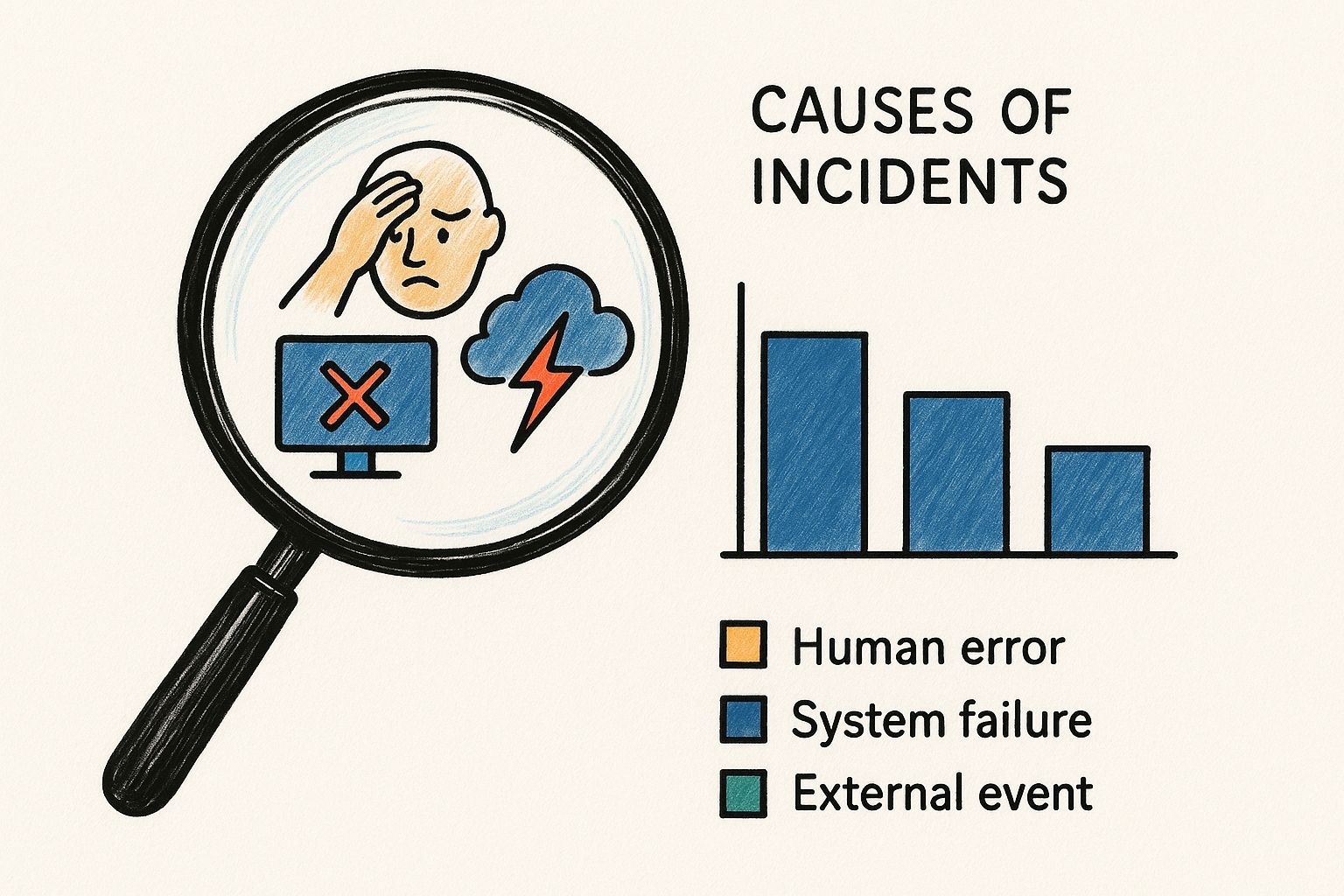
Take a look at the infographic below. It highlights the key areas to focus on when building your ORM foundation: human error, system failures, and external events. These are the main sources of operational risk that can really mess with your business.
As you can see, managing operational risk effectively requires a multi-pronged approach. You have to tackle both internal vulnerabilities (like human error and system failures) and external pressures (like those unexpected external events). Each of these areas needs specific strategies and controls to make sure you’re mitigating risk across the board.
A strong foundation starts with a clear governance structure. This means defining roles, responsibilities, and who’s accountable at every level of your organization. When everyone knows their role in managing risk, you can proactively address any critical gaps. For instance, assigning specific people to oversee certain risk categories really helps focus expertise and improves accountability. Plus, make sure you have clear reporting lines so risk information gets to the decision-makers quickly.
Next, you’ll want to define your organization’s risk appetite. This basically outlines how much risk your organization is willing to accept to achieve its goals. A well-defined risk appetite helps guide decision-making and ensures that any risks you take are carefully considered and strategic. It’s all about understanding the potential impact of different risks and weighing them against the potential rewards. This gives you a solid framework for making smart decisions about which risks to accept, mitigate, or avoid altogether.
Designing a Scalable Framework
Your ORM framework needs to be scalable. It has to be able to adapt as your business grows and changes – think size, complexity, and even the external environment. A rigid framework will quickly become outdated and useless, making it harder to manage risk effectively. But a flexible and adaptable framework lets you adjust as new risks pop up and the business environment shifts.
To design a scalable framework, think about using modular components. These can be easily tweaked and expanded. This approach lets you make gradual improvements and avoids having to completely overhaul the system as your business evolves. For example, you might begin with a simple risk assessment process and gradually add more advanced tools and techniques as your organization gets more sophisticated.
Before we talk about implementation, let’s look at how different framework components can look across different maturity levels. The following table provides a quick comparison:
Operational Risk Framework Components Comparison
Comparison of essential framework elements across different organizational maturity levels
Framework Component
Basic Level
Intermediate Level
Advanced Level
Governance Structure
Defined roles and responsibilities
Documented procedures and escalation paths
Automated workflows and real-time monitoring
Risk Appetite
High-level statement
Quantified risk thresholds
Dynamic risk appetite adjustments based on performance
Risk Identification
Basic checklists and workshops
Scenario analysis and key risk indicators
Predictive modeling and emerging risk identification
Risk Assessment
Qualitative impact and likelihood assessment
Quantitative risk modeling
Stress testing and sensitivity analysis
Risk Response
Basic mitigation plans
Defined risk owners and action plans
Integrated risk response and business continuity plans
Monitoring and Reporting
Periodic reporting
Regular monitoring and reporting with key metrics
Real-time dashboards and automated alerts
This table shows how each component evolves as an organization matures in its risk management practices. For instance, governance moves from simply defining roles to incorporating automated workflows. Risk appetite becomes more precise, and risk identification utilizes more sophisticated techniques like predictive modeling.
Overcoming Implementation Challenges
Implementing a new ORM framework can be tricky. Common problems include lack of buy-in from stakeholders, not enough resources, and inadequate training. Tackling these challenges requires proactive strategies and a commitment to continuous improvement. Getting stakeholders on board is essential. Clearly communicate the benefits of ORM and involve key people in the development and implementation process. This collaborative approach builds ownership and makes it more likely that everyone will adopt the new framework.
Don’t forget about training! Provide staff with adequate training on ORM principles and practices. This empowers your employees to identify and manage risks themselves, which strengthens your entire organization’s risk management capabilities. Regularly review and update your framework based on performance data, new risks, and lessons learned. This iterative approach keeps your ORM system relevant and effective in the long run. Having a solid business continuity plan checklist is also part of a good risk management foundation. Take a look at a comprehensive checklist to make sure you haven’t missed any crucial steps. Being proactive like this is key to minimizing disruptions and keeping things running smoothly, even when unexpected events occur.
Spotting Tomorrow’s Risks Before They Hit Today
Lots of companies spend their time putting out fires – dealing with operational problems that have already happened. But the truly smart ones are looking ahead, trying to figure out what could go wrong before it actually does. This proactive approach to operational risk management is key to staying competitive and building a business that lasts. So how do these forward-thinking companies actually do it? How do they spot those emerging risks?
Leveraging Data and Intelligence
One major way is through data analytics. By looking at past operational data, companies can see patterns and trends that might hint at future problems. Think of it like finding weak spots in a system before they break. For example, maybe a company notices a ton of similar customer service complaints – that could be a sign of a bigger issue.
Beyond internal data, it’s also smart to keep an eye on what’s happening in the wider industry. Industry intelligence, like reports and research, can give you a heads-up about risks you might not have even considered.
A good example is the ORX Operational Risk Horizon report. They talked to over 47 banks, insurance companies, and asset management firms around the world and pinpointed 11 emerging risks. These include things like information security worries, data breaches, and even physical security threats. Want to learn more? Check it out here. Knowing what’s on the horizon lets companies get prepared and lessen the impact of potential problems.
Proactive Risk Assessments and Scenario Planning
Data is great, but thorough risk assessments are also essential. This isn’t just about checking off boxes for compliance – it’s about really digging deep to find hidden vulnerabilities. Imagine a company checking its supply chain for potential disruptions, like, say, a natural disaster or political instability. That lets them create backup plans and keep things running smoothly. A big part of this is having a solid business continuity plan. Need a refresher? Here’s a handy business continuity plan checklist.
Another useful tool is scenario planning. Basically, you create “what if” scenarios – imagined future events – and see how they might affect your business. Thinking through different possibilities helps you spot vulnerabilities and come up with ways to handle them. A company could, for instance, run a scenario for a major cyberattack and map out exactly how they’d respond and recover.
Building Early Warning Systems
Finally, you need good early warning systems. These systems act like tripwires, alerting you to emerging risks while they’re still small and relatively easy to deal with. This means tracking key risk indicators (KRIs) and setting thresholds – if a KRI goes above a certain level, alarms go off. Maybe a company tracks the number of product complaints. If the complaints suddenly spike, that triggers an investigation. Catching potential problems early means avoiding major headaches (and expenses) down the line. It also lets you focus your resources where they matter most.
Creating Controls That Actually Prevent Problems
So you’ve spotted tomorrow’s risks before they even show up? Great! But the real magic of managing operational risk isn’t just about early warning systems—it’s about building controls that actually stop failures in their tracks. This proactive approach, shifting from simply detecting problems to preventing them, drastically reduces the chance of small hiccups escalating into full-blown crises.
Layered Defense Strategies
Think of effective prevention like a well-designed castle defense, with layers of protection. Here’s a simple breakdown:
Process-Level Controls: These are your standardized checklists and workflows—think of them as the guards at the gate, catching human errors right away.
System-Level Controls: Automated validations, data integrity checks, and failover systems. These are like the castle walls, stopping technical glitches before they cause any real damage.
Human-Level Controls: Role rotations, peer reviews, and clear escalation paths—these are the officers in the castle, making sure there’s no single point of failure.
Oversight-Level Controls: Executive dashboards and regular audits—think of these as the king surveying his domain, ensuring everything’s running smoothly and all the controls are effective.
If one layer of defense fails, another is right there to back it up.
Control Design Principles
Keep your controls simple, scalable, and in line with your risk appetite. Also, enforce separation of duties. This minimizes conflicts of interest and boosts transparency, just like having independent checks and balances within your castle walls.
Automation Versus Human Oversight
Automation is fantastic for repetitive, rule-based checks. It never gets tired! However, for complex judgments, you still need human intuition and context. Finding the right balance prevents alert overload (nobody wants a constantly blaring alarm) and ensures each control delivers real value.
Proactive Control Benefits
Want to see some real results? Organizations using proactive controls have seen a whopping 68% reduction in significant operational incidents and a 43% drop in their average loss per event, compared to those relying mainly on detective controls. Pretty impressive, right? Explore this topic further.
Actionable Monitoring Without Alert Fatigue
Monitoring is key, but it’s easy to get overwhelmed. Here’s how to make sure your monitoring system is actually helpful:
Focus on key risk indicators (KRIs) tied to your most critical processes.
Set thresholds that only trigger alerts for serious issues—no more constant beeping!
Send notifications to the right people with clear escalation procedures.
Review and adjust your thresholds regularly to keep up with evolving risks.
Maintaining Control Effectiveness
As your organization grows, so too must your controls. Here’s how to stay on top of things:
Regular control health checks with independent reviews.
Feedback loops where your frontline teams can suggest improvements—they’re the ones in the trenches, after all!
Keep track of control changes with versioning and documentation.
Provide training updates to reflect any new or revised controls.
By embedding preventive controls at every level, you transform risk management from reactive firefighting into strategic, proactive protection. It’s like having a strong, well-maintained castle—ready for anything.
Building a Culture That Actually Cares About Risk
Let’s be honest, even the slickest risk management software is worthless if your team doesn’t get it. This section dives into how to build real risk awareness across your organization. We’re talking about moving past those yawn-inducing, mandatory training sessions and actually changing how people work.
Engaging Leadership and Empowering Employees
The most successful organizations don’t just talk about risk with their employees, they get them involved. Leadership sets the standard, showing that risk management is important. For example, having executives regularly discuss risk in meetings and factor it into strategic decisions demonstrates that it’s a real priority, not just an afterthought.
Frontline employees are your secret weapon for spotting risks early. Giving them the power to identify and report potential issues – without fear of getting blamed – makes your whole risk management system stronger. Think of a customer service rep noticing a recurring problem with a product. If they feel comfortable speaking up, the company can fix the issue before it blows up. This creates a proactive environment where everyone’s involved in reducing risk.
Effective Governance and Communication
Solid governance structures make sure risk management isn’t just all talk. Having clear roles, responsibilities, and reporting procedures ensures that important risk information gets to the decision-makers quickly. For example, assigning risk owners for certain areas ensures accountability.
Good communication is also essential. Regularly sharing updates about identified risks, near misses, and successful mitigation efforts keeps risk on everyone’s radar. It’s important to explain how risk management connects to each person’s role. For instance, showing the sales team how a data breach could affect their sales figures could motivate them to use safer data practices.
Working risk considerations into performance management really emphasizes its importance. Adding risk management objectives to performance reviews makes it a measurable part of someone’s job. But it’s important to do this without drowning everyone in paperwork. The focus should be on meaningful risk management actions, not just ticking boxes.
It’s the same with strategic planning. By considering operational risks during the planning stages, businesses can make smart decisions about how they use resources and which projects to prioritize. This builds risk management into the core of how the business runs.
Assessing Risk Culture Maturity
To see where your organization sits on its risk culture journey, check out this table:
Risk Culture Maturity Assessment: Key indicators and characteristics of organizational risk culture at different maturity stages.
Culture Element
Reactive
Proactive
Resilient
Risk Awareness
Limited awareness, primarily focused on compliance
Risk is discussed openly, employees understand its importance
Risk is ingrained in daily activities and decision-making
Risk Reporting
Reporting is reactive, often after incidents occur
Proactive reporting of potential risks is encouraged
Risk reporting is seamless and integrated into workflows
Accountability
Limited accountability for risk management
Clear roles and responsibilities for managing risk
Shared accountability for risk across the organization
Learning from Incidents
Incidents are viewed as isolated events
Lessons learned from incidents are used to improve processes
Continuous learning from incidents and near misses is embedded in the culture
The shift from a reactive to a resilient risk culture takes time and effort, along with a commitment to always improving. But by building a culture that truly values risk management, organizations can become more resilient, boost their performance, and better handle today’s complex business world.
Measuring What Matters and Improving Continuously
Effective operational risk management is about way more than just ticking boxes for compliance. You need a way to measure how well your risk program is actually working and, even better, get a glimpse into how it might perform in the future. Forget just recording what went wrong yesterday – you want to know what could go wrong tomorrow. This means switching gears from reactive reporting to proactive prediction. Let’s look at how to measure the stuff that really matters and build a culture of getting better, bit by bit.
Key Performance Indicators (KPIs) That Drive Improvement
To manage operational risk, you need the right Key Performance Indicators (KPIs). We’re not talking about vanity metrics here. These KPIs should reflect how effective your risk management is and even predict how things might shake out down the line.
For example, tracking near misses can tell you more than just counting actual incidents. Lots of near misses could mean there are holes in your preventative measures, even if you haven’t had a major incident yet. This lets you fix potential problems before they blow up.
Another useful KPI is the time it takes to recover from an incident. A quick recovery time shows a resilient organization that can handle disruptions.
Benchmarking and Effectiveness Assessments
Benchmarks give your KPIs some context. They let you see how you stack up against industry best practices and spot areas where you can improve. Internal benchmarking (comparing performance across different teams or departments) can also help you find best practices within your own company.
Effectiveness assessments go hand-in-hand with benchmarking. These assessments help you find weaknesses in your risk management program before they become major headaches. They can be as simple as reviewing incident reports or as involved as running simulated crisis drills.
Continuous Improvement: Adapting to the Changing Landscape
Business is always changing, so your operational risk management has to keep up. Continuous improvement isn’t a one-and-done project; it’s an ongoing process of tweaking and refining. As your business changes, your risk management should too.
This means checking your KPIs, benchmarks, and assessment methods regularly to make sure they’re still relevant. New technologies or regulation changes might mean you need to update your risk assessments or put new controls in place. Regularly reviewing your operational risk appetite is also key, ensuring it’s still in line with your overall business strategy.
Demonstrating the Value of Risk Management
You need to be able to show stakeholders that your risk management program isn’t just a cost, but a valuable investment. By tracking and reporting KPIs like lower incident costs or faster recovery times, you can show the real benefits of your program. This not only justifies the resources you’re putting into risk management, but also gets more people on board with investing in and improving it. You might find this interesting: How to Master Data-Driven Decision Making.
This data-driven way of thinking also helps you find high-impact areas to improve and optimize. By focusing on the areas with the biggest potential, you get the most bang for your buck. This might mean strengthening certain controls, improving training, or investing in new tech that helps you spot and manage emerging risks.
Key Takeaways
Managing operational risk effectively isn’t just about dodging disasters. It’s about building a stronger, more resilient business. This section gives you a practical roadmap for revamping your approach to operational risk management (ORM), turning it from a compliance headache into a real competitive edge. We’ll cover key implementation steps, realistic timelines, the resources you’ll need, and what success looks like for organizations of all shapes and sizes.
Building Your Risk Management Foundation
A solid ORM framework doesn’t appear overnight. It takes a strong foundation. Begin by clearly defining roles and responsibilities for risk management. This establishes accountability and avoids critical gaps in your defenses. Next, define your organization’s risk appetite: how much risk are you comfortable taking to hit your business objectives? This sets the stage for smart decision-making and ensures strategic consideration of all risks.
Proactive Risk Identification and Control
Don’t wait for trouble to find you. Use data analytics, industry insights, and scenario planning to anticipate emerging risks. Tools like Key Risk Indicators (KRIs) can be your early warning system, alerting you to potential issues before they escalate. Moving from reacting to problems to preventing them is key. Instead of just recording losses, create control systems that stop them from happening. This calls for a multi-layered defense strategy, using process-level controls (like checklists), system-level controls (like automated validations), and human-level controls (like peer reviews).
Cultivating a Risk-Aware Culture
Technology isn’t a magic bullet. You need a culture that truly values risk management. Get leadership on board to champion the cause, showing its importance through their actions and choices. Empower your front-line employees to spot and report potential risks without fear of being blamed. Encourage open communication about risks, near misses, and successful mitigation efforts. Make risk management a regular part of the conversation, not just a training topic. Weaving risk considerations into performance management and strategic planning reinforces its value.
Measuring Progress and Continuous Improvement
Choose Key Performance Indicators (KPIs) that genuinely reflect your risk management effectiveness. Track metrics like the number of near misses, recovery time from incidents, and the financial impact of operational failures. Regularly compare your performance against others in your industry and conduct effectiveness assessments to identify areas for improvement. Remember, ORM is an ongoing journey. Regularly review and refresh your framework, controls, and KPIs to adapt to the changing business environment and new threats. As your organization and its risk profile change, so should your ORM framework. For instance, your approach to operational resilience might shift from focusing on basic business processes to a more comprehensive, end-to-end view of critical operations, ensuring business continuity even with major disruptions.
Quick Wins and Long-Term Strategies
Some improvements can bring immediate value. Tightening a specific control in a high-risk area or rolling out a new reporting system can quickly produce tangible results. These quick wins create momentum and show the value of strong risk management. But don’t forget the long game. Invest in building a robust risk culture, creating effective risk assessment methods, and implementing organization-wide risk management systems. These strategic initiatives will provide long-lasting protection and build a sustainable competitive advantage.
Overcoming Challenges and Maintaining Momentum
Implementing a complete risk management program isn’t always smooth sailing. You might encounter resistance, limited resources, or difficulty integrating new processes into current workflows. Open communication, stakeholder engagement, and a phased implementation can help you overcome these hurdles. Celebrate successes, both big and small, to maintain momentum and demonstrate the value of your work. Keep stakeholders in the loop on your progress, emphasizing the positive effects of risk management on business performance and resilience.
Ready to transform your risk management approach and unlock your business’s full potential? Explore how NILG.AI can help with tailored AI solutions, strategic roadmaps, and expert guidance to build a truly resilient and successful future. Visit NILG.AI today to learn more.
Special offers, latest news and quality content in your inbox.
Signup single post
Recommended Articles
Article
Transform Your Growth with custom ai software development in 2026
Apr 1, 2026 in
Guide: Explainer
Explore how custom ai software development can boost efficiency, cut costs, and deliver measurable value - find trusted partners and practical steps for 2026.
Discover how AI for customer service can transform your support operations. Learn practical strategies to reduce costs, improve satisfaction, and drive growth.
How Might We Statements: Turn Challenges into Opportunities
Mar 15, 2026 in
Guide: Explainer
Discover how might we statements transform complex challenges into real opportunities. Learn practical crafting tips, workshops, and real-world examples.
We use cookies on our website to give you the most relevant experience by remembering your preferences and repeat visits. By clicking “Accept All”, you consent to the use of ALL the cookies. However, you may visit "Cookie Settings" to provide a controlled consent.
This website uses cookies to improve your experience while you navigate through the website. Out of these, the cookies that are categorized as necessary are stored on your browser as they are essential for the working of basic functionalities of the website. We also use third-party cookies that help us analyze and understand how you use this website. These cookies will be stored in your browser only with your consent. You also have the option to opt-out of these cookies. But opting out of some of these cookies may affect your browsing experience.
Necessary cookies are absolutely essential for the website to function properly. These cookies ensure basic functionalities and security features of the website, anonymously.
Cookie
Duration
Description
cookielawinfo-checkbox-analytics
11 months
This cookie is set by GDPR Cookie Consent plugin. The cookie is used to store the user consent for the cookies in the category "Analytics".
cookielawinfo-checkbox-functional
11 months
The cookie is set by GDPR cookie consent to record the user consent for the cookies in the category "Functional".
cookielawinfo-checkbox-necessary
11 months
This cookie is set by GDPR Cookie Consent plugin. The cookies is used to store the user consent for the cookies in the category "Necessary".
cookielawinfo-checkbox-others
11 months
This cookie is set by GDPR Cookie Consent plugin. The cookie is used to store the user consent for the cookies in the category "Other.
cookielawinfo-checkbox-performance
11 months
This cookie is set by GDPR Cookie Consent plugin. The cookie is used to store the user consent for the cookies in the category "Performance".
viewed_cookie_policy
11 months
The cookie is set by the GDPR Cookie Consent plugin and is used to store whether or not user has consented to the use of cookies. It does not store any personal data.
Functional cookies help to perform certain functionalities like sharing the content of the website on social media platforms, collect feedbacks, and other third-party features.
Performance cookies are used to understand and analyze the key performance indexes of the website which helps in delivering a better user experience for the visitors.
Analytical cookies are used to understand how visitors interact with the website. These cookies help provide information on metrics the number of visitors, bounce rate, traffic source, etc.
Advertisement cookies are used to provide visitors with relevant ads and marketing campaigns. These cookies track visitors across websites and collect information to provide customized ads.