AI Automations • AI4business • Artificial Intelligence •
Top 7 Benefits of AI in Business for 2025
NILG.AI on Aug 5, 2025
?>
Staying competitive is no longer about just working harder; it’s about working smarter. Artificial Intelligence has shifted from a sci-fi concept to a core business asset that’s fundamentally reshaping how companies operate. Organizations that embrace AI aren’t merely fine-tuning their processes. They’re pioneering new methods to deliver value, connect with customers, and guide their strategic vision.
But what are the concrete benefits of AI in business? This guide moves past the buzzwords to deliver a straightforward, actionable roundup of what truly matters. We will break down seven specific areas where AI drives significant results, complete with real-world scenarios, practical implementation advice, and the key metrics you need to track success.
You’ll learn how to apply AI for everything from enhancing customer support and automating routine tasks to uncovering data-driven insights and personalizing marketing efforts. Whether you’re a startup founder aiming to scale efficiently or an enterprise leader looking to innovate, understanding these benefits is the first step toward genuine transformation. Let’s explore how AI can become your most valuable partner for growth.
1. Enhanced Customer Service and Support
Let’s be real, nobody enjoys being on hold. One of the most immediate and impactful benefits of AI in business is its power to completely transform the customer service experience. AI-powered systems, like chatbots and virtual assistants, work around the clock, offering instant, 24/7 support without ever needing a coffee break.
These aren’t your old, clunky automated menus. Modern AI uses Natural Language Processing (NLP) to understand what customers are actually saying, whether they’re typing a query on your website or speaking to a virtual agent. This allows the system to provide accurate, helpful answers instantly, resolving a huge volume of common issues on the spot. Think of Bank of America’s virtual assistant, Erica, which handles over a billion customer interactions a year, or Sephora’s chatbot that gives personalized beauty advice.
Getting It Right: Tips for Implementation
Start Small, Win Big: Begin by automating responses to your most frequent and repetitive questions. Use this foundation to gather data and gradually train your AI to handle more complex scenarios.
Perfect the Handoff: Ensure there’s a seamless and frustration-free process to transfer a customer to a human agent when the AI reaches its limit. A clunky handoff can erase all the goodwill you’ve built.
Maintain Your Voice: Your AI is an extension of your brand. Program it to communicate with the same tone and personality your customers expect, whether it’s formal and professional or friendly and fun.
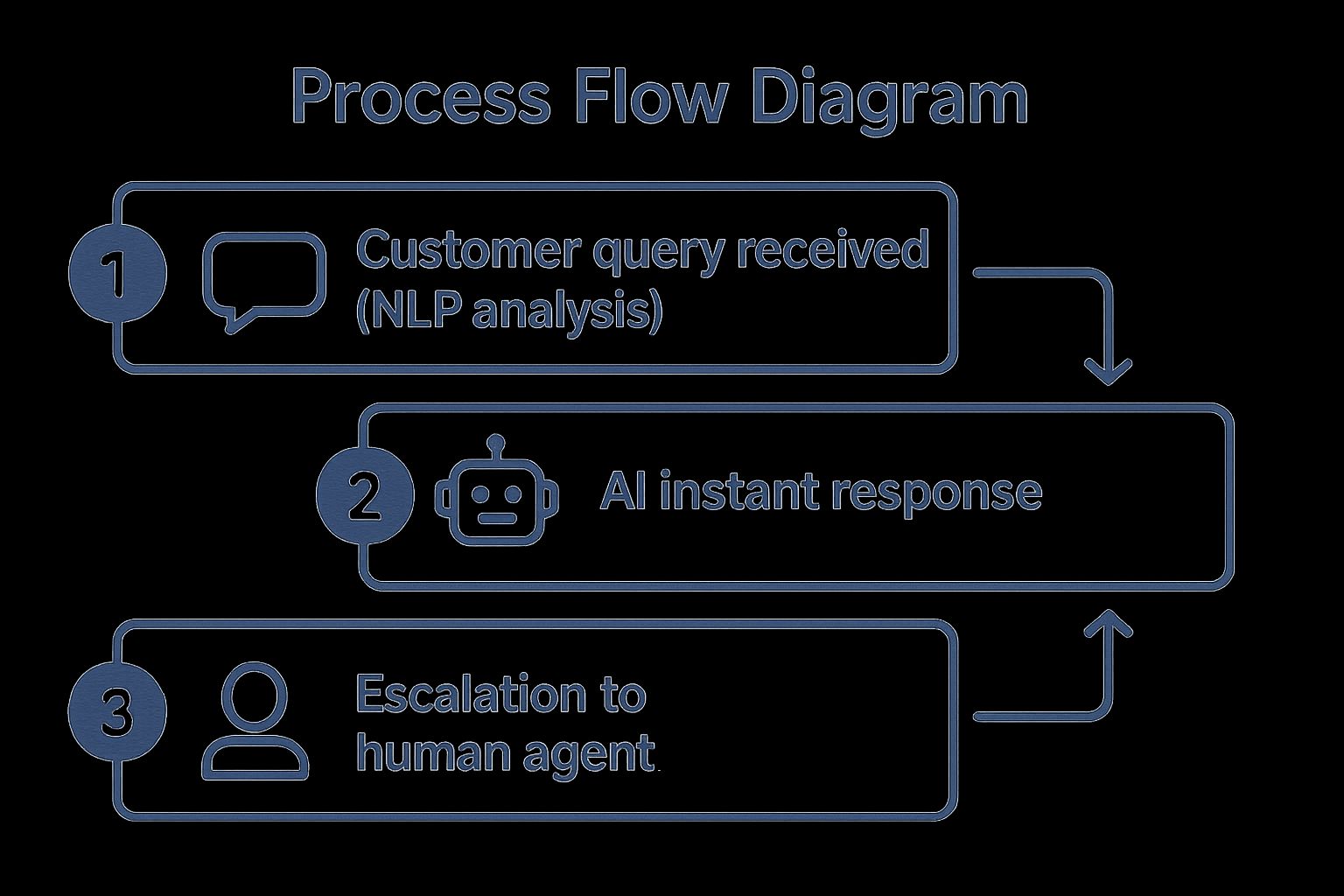
A key element of a successful AI support system is the automated query-handling process. This workflow ensures that customer issues are addressed efficiently, either through instant AI resolution or by escalating to the right human expert.
This streamlined process allows businesses to filter and resolve the majority of simple queries automatically, freeing up human agents to focus their expertise on more complex, high-value customer interactions.
2. Intelligent Process Automation and Efficiency
Think of all the repetitive, time-consuming tasks that clog up your team’s day: data entry, document processing, report generation. Intelligent Process Automation (IPA) is here to take over, but it’s much smarter than traditional automation. It uses machine learning and cognitive tech to handle complex, variable tasks, learning and adapting over time to optimize workflows and boost accuracy.
This isn’t just about speeding things up; it’s about fundamentally rethinking how work gets done. For example, JPMorgan Chase’s COIN platform uses AI to analyze legal documents, completing in seconds what took lawyers 360,000 hours annually. Similarly, Walmart employs AI for sophisticated inventory management across its thousands of stores, ensuring shelves are stocked and waste is minimized. These examples highlight one of the most powerful benefits of AI in business: freeing up human talent for strategic, creative work that machines can’t do. For a deeper dive into how AI revolutionizes operational processes, explore our comprehensive guide on AI-powered workflow automation.
Getting It Right: Tips for Implementation
Target High-Volume Tasks First: Identify repetitive, rule-based processes that consume the most employee hours. These are your prime candidates for initial automation and offer the quickest wins.
Map Before You Automate: Don’t just automate a broken process. Conduct a thorough mapping of your existing workflow to identify bottlenecks and areas for improvement before you implement any AI tools.
Start with a Pilot Program: Launch a small-scale pilot project to demonstrate the value and ROI of automation. Use this success story to build momentum and get buy-in for wider adoption.
Invest in Your People: Automation changes roles, it doesn’t just eliminate them. Focus on training and change management to help your team adapt to new responsibilities and work alongside their new AI colleagues.
By automating intelligently, businesses can unlock massive efficiency gains, reduce errors, and allow their teams to focus on high-impact initiatives. You can learn more about how to get started with intelligent process automation.
3. Data-Driven Insights and Predictive Analytics
In today’s market, gut feelings just don’t cut it anymore. Businesses are swimming in data, but much of it remains untapped potential. This is where AI truly shines, acting as a master interpreter that turns raw numbers into a strategic roadmap. It excels at spotting subtle patterns, correlations, and trends that are practically invisible to the human eye, giving you a crystal-clear view of what’s really happening in your business.
AI’s ability to offer these data-driven insights is one of the most profound benefits of AI in business. Predictive analytics takes this a step further by using machine learning to forecast future outcomes with remarkable accuracy. Think of Netflix’s recommendation engine, which is so effective that it drives 80% of what users watch. Or consider Zara, which uses demand forecasting to optimize inventory, slashing waste by an estimated 30%. These companies aren’t just reacting to the market; they’re actively shaping their future based on what the data tells them is coming next.
Getting It Right: Tips for Implementation
Garbage In, Garbage Out: Before you even think about AI, ensure your data is clean, consistent, and high-quality. Your insights will only be as reliable as the data you feed the system.
Start with a Specific Goal: Don’t try to analyze everything at once. Pick a specific, high-impact business problem, like customer churn or inventory management, and focus your initial AI efforts there.
Human-in-the-Loop: AI provides the “what,” but human expertise provides the “why.” Combine AI-generated insights with the contextual knowledge of your team to make the most informed decisions.
Keep Your Models Fresh: Markets change, and so does customer behavior. Regularly validate and update your predictive models to ensure they remain accurate and relevant.
A cornerstone of this approach is leveraging a reliable analytics platform to make sense of complex information. Tools like Tableau and Power BI are excellent at this, transforming dense datasets into understandable visuals. To dig deeper into how this works, you can learn more about the benefits of predictive analytics. By making data accessible and actionable, AI empowers organizations to stop guessing and start making proactive, evidence-based decisions that drive growth and efficiency.
4. Personalized Marketing and Customer Experience
Generic, one-size-fits-all marketing is dead. Today’s consumers expect brands to understand their individual needs, and this is where AI shines as a major benefit in business. AI algorithms analyze vast amounts of data, including browsing history, past purchases, and real-time interactions, to build a deep understanding of each customer. This allows businesses to deliver hyper-personalized content, product recommendations, and offers that feel uniquely crafted for the individual.
This isn’t just about adding a first name to an email. AI creates dynamic customer journeys that adapt in real time. For example, Amazon’s legendary recommendation engine is responsible for an estimated 35% of its total revenue. Similarly, Spotify’s AI-curated “Discover Weekly” playlists are so effective they’ve been shown to increase user engagement significantly. It’s about creating a one-to-one conversation at scale, making customers feel seen and understood.
Getting It Right: Tips for Implementation
Combine Data Sources: Don’t rely on just one type of data. The most powerful personalization comes from combining demographic, behavioral (what they do), and contextual (where and when they are) data for a complete customer view.
Balance Personalization with Privacy: Be transparent about how you use customer data. Always prioritize privacy and give users control over their information to build trust, which is crucial for long-term loyalty.
Test and Optimize: Personalization isn’t a “set it and forget it” strategy. Continuously test different levels of personalization, from subtle nudges to fully customized landing pages, to find the optimal approach that resonates with your audience.
A key element for success is starting with a solid data foundation and using powerful platforms like Salesforce Marketing Cloud or Adobe Experience Cloud. This technology helps ensure that every marketing touchpoint, from an email campaign to a website visit, is relevant and valuable to the customer, drastically improving engagement and conversion rates.
5. Cost Reduction and Resource Optimization
Let’s talk about the bottom line. Beyond boosting sales or improving service, one of the most powerful benefits of AI in business is its surgical ability to find and eliminate financial waste. AI systems act like a team of hyper-efficient auditors, constantly analyzing every operational detail to optimize how you use your money, materials, and manpower.
These intelligent systems dig deep into spending patterns, supply chains, and operational workflows to pinpoint inefficiencies that human eyes might miss. Think of Google, which used AI to manage its massive data centers, cutting cooling costs by a staggering 40%. Similarly, FedEx leverages AI-powered route optimization to save over $200 million each year. This isn’t just about trimming a few expenses; it’s about fundamentally re-engineering your cost structure for maximum efficiency.
Getting It Right: Tips for Implementation
Start with High-Impact Areas: Don’t try to boil the ocean. Begin by applying AI to a specific, high-cost area like energy consumption, logistics, or inventory management where you can get a clear and measurable win.
Establish Your Baseline: Before you flip the switch on any AI tool, you need to know your starting point. Meticulously document your current costs and performance metrics to accurately measure the financial impact of the new system.
Involve Your Finance Team Early: Your CFO and finance department are crucial allies. Involve them in the planning process to ensure the project aligns with broader financial goals and that the reported savings are tracked accurately.
A core strength of AI in this domain is its capacity for predictive maintenance and resource allocation. By analyzing historical data and real-time inputs, systems like IBM Maximo or GE Predix can forecast equipment failures before they happen. This proactive approach prevents costly downtime and emergency repairs, turning a reactive expense into a predictable, managed cost. It allows businesses to move from a “fix-it-when-it-breaks” model to a much more cost-effective “fix-it-before-it-breaks” strategy.
6. Enhanced Decision Making and Strategic Planning
Gut feelings are great, but in today’s hyper-competitive landscape, they’re not enough. One of the most powerful benefits of AI in business is its ability to supercharge strategic decision-making. AI algorithms can sift through massive datasets, identify hidden patterns, and run complex simulations that are simply beyond human capacity, providing leaders with evidence-based insights to steer the ship.
This isn’t about replacing human intuition; it’s about augmenting it. AI can process real-time market data, competitor actions, and internal performance metrics to forecast outcomes and recommend optimal paths forward. For example, investment firm Bridgewater Associates manages over $150 billion in assets using sophisticated AI models to inform its decisions. Similarly, Airbnb leverages AI not just for pricing recommendations but also for making critical market expansion choices, ensuring they invest in the right places at the right time.
Getting It Right: Tips for Implementation
Combine AI with Human Judgment: Treat AI recommendations as a powerful advisory tool, not an absolute command. The best decisions come from blending data-driven insights with human experience, context, and ethical oversight.
Establish Clear Frameworks: Before deploying an AI model, define the key metrics and criteria for success. This ensures the AI is optimized to solve the right problem and that its outputs are easily interpretable by your team.
Create Feedback Loops: Your AI models are not static. Implement a system where the outcomes of AI-assisted decisions are fed back into the system, allowing it to learn from its successes and failures and improve over time.
A critical aspect of AI-driven strategy is its ability to test potential decisions before they are made. This “what-if” analysis helps businesses anticipate market changes and reduce the risk associated with major strategic shifts, from product development to supply chain restructuring. This is how leaders like those at General Motors leverage AI to guide strategic product development, making more confident bets on future consumer needs.
7. Risk Management and Fraud Detection
In an increasingly digital world, the battle against fraud is relentless and ever-evolving. This is where another one of the major benefits of AI in business shines: its ability to supercharge risk management and fraud detection. AI systems work tirelessly in the background, analyzing millions of transactions, user behaviors, and data points in real time to spot suspicious patterns that would be impossible for a human to catch.
This isn’t just about blocking stolen credit cards. Advanced machine learning algorithms can identify sophisticated, multi-layered fraud schemes and emerging threats long before they cause significant damage. For example, PayPal uses AI to prevent billions in fraud annually, while Mastercard’s AI system analyzes over 120 billion transactions to protect consumers. These systems learn from every transaction, getting smarter and more accurate with each new piece of data they process, moving far beyond outdated, rule-based detection methods.
Getting It Right: Tips for Implementation
Focus Your Firepower: Start by applying AI to your most high-risk and high-volume transaction types. This is where you’ll see the most immediate impact and gather valuable data to refine your models.
Balance Security and Experience: Don’t let your fraud prevention measures create a frustrating customer experience. Tune your AI to minimize false positives, ensuring legitimate customers aren’t constantly blocked or challenged.
Keep Your Models Fresh: Fraudsters are always developing new tactics. You must regularly update your AI models with new fraud patterns and data to stay ahead of emerging threats and maintain high accuracy.
Maintain Human Oversight: AI is incredibly powerful, but it shouldn’t operate in a vacuum. Keep human experts in the loop to review complex or ambiguous cases, handle escalations, and provide the final judgment call when needed.
Effectively deploying AI is a cornerstone of modern security, crucial for managing operational risk and protecting both your business and your customers. This proactive approach allows organizations to move from a reactive to a predictive stance on security, identifying and neutralizing threats before they escalate. By implementing these strategies, you can build a resilient defense system that adapts to the constantly changing landscape of digital risk.
Your Next Move: Turning AI Benefits into Business Reality
We’ve journeyed through seven game-changing benefits of AI in business, and the conclusion is inescapable. Artificial intelligence is no longer a futuristic concept from science fiction; it’s a practical, powerful tool actively reshaping industries, redefining efficiency, and creating unprecedented value right now. From delivering hyper-personalized customer experiences to automating tedious back-office tasks, AI is the engine driving the next wave of competitive advantage.
The real magic, however, isn’t just knowing these benefits exist. It’s about translating that knowledge into a tangible strategy that fits your unique business landscape. The path forward can seem complex, but it begins with a single, focused question: Where does my business feel the most friction? Answering this is the first step toward unlocking the immense potential we’ve discussed.
From Theory to Action: Your AI Launchpad
The gap between understanding the benefits of AI in business and actually reaping them can feel vast. But bridging it is more manageable than you think. You don’t need a massive, company-wide overhaul from day one. Instead, think of it as a series of strategic, high-impact projects.
Your immediate next steps should be grounded in practical assessment and planning:
Identify Your Biggest Bottleneck: Look back at the seven benefits we covered. Which one resonates most with your current challenges? Is it sluggish customer support? Inefficient operational workflows? A lack of deep, predictive insights from your data? Pinpoint the area where an AI-driven solution would deliver the most significant and immediate impact.
Start Small, Win Big: Select a single, well-defined pilot project. This could be implementing an AI chatbot to handle common customer queries or using a predictive analytics tool to forecast inventory needs for a specific product line. A successful pilot builds momentum, secures stakeholder buy-in, and provides a valuable learning experience for larger initiatives.
Audit Your Data Readiness: AI thrives on data. Before you can deploy advanced models for fraud detection or personalized marketing, you must assess the quality, accessibility, and structure of your data. A clean, well-organized data ecosystem is the foundation upon which all successful AI strategies are built.
The Real Takeaway: AI is a Journey, Not a Destination
Ultimately, integrating AI is about more than just technology; it’s a strategic shift toward becoming a more intelligent, agile, and resilient organization. The benefits of AI in business are not just about cutting costs or automating tasks. They are about empowering your teams with the tools they need to make smarter decisions, freeing them from repetitive work to focus on innovation, and building deeper, more meaningful relationships with your customers.
The journey starts today. By moving from passive learning to active planning, you can begin to transform these powerful concepts into a concrete reality that drives measurable growth and secures your company’s place at the forefront of your industry. Don’t wait for the future to happen to you, start building it with AI.
Ready to turn your AI ambitions into a strategic roadmap for success? The experts at NILG.AI specialize in helping businesses like yours identify high-impact opportunities and build custom AI solutions that deliver real-world results. Request a proposal to learn how our tailored AI development and strategic consulting can accelerate your journey.
Like this story?
Subscribe to Our Newsletter
Special offers, latest news and quality content in your inbox.
Signup single post
Recommended Articles
Article
Transform Your Growth with custom ai software development in 2026
Apr 1, 2026 in
Guide: Explainer
Explore how custom ai software development can boost efficiency, cut costs, and deliver measurable value - find trusted partners and practical steps for 2026.
Discover how AI for customer service can transform your support operations. Learn practical strategies to reduce costs, improve satisfaction, and drive growth.
How Might We Statements: Turn Challenges into Opportunities
Mar 15, 2026 in
Guide: Explainer
Discover how might we statements transform complex challenges into real opportunities. Learn practical crafting tips, workshops, and real-world examples.
We use cookies on our website to give you the most relevant experience by remembering your preferences and repeat visits. By clicking “Accept All”, you consent to the use of ALL the cookies. However, you may visit "Cookie Settings" to provide a controlled consent.
This website uses cookies to improve your experience while you navigate through the website. Out of these, the cookies that are categorized as necessary are stored on your browser as they are essential for the working of basic functionalities of the website. We also use third-party cookies that help us analyze and understand how you use this website. These cookies will be stored in your browser only with your consent. You also have the option to opt-out of these cookies. But opting out of some of these cookies may affect your browsing experience.
Necessary cookies are absolutely essential for the website to function properly. These cookies ensure basic functionalities and security features of the website, anonymously.
Cookie
Duration
Description
cookielawinfo-checkbox-analytics
11 months
This cookie is set by GDPR Cookie Consent plugin. The cookie is used to store the user consent for the cookies in the category "Analytics".
cookielawinfo-checkbox-functional
11 months
The cookie is set by GDPR cookie consent to record the user consent for the cookies in the category "Functional".
cookielawinfo-checkbox-necessary
11 months
This cookie is set by GDPR Cookie Consent plugin. The cookies is used to store the user consent for the cookies in the category "Necessary".
cookielawinfo-checkbox-others
11 months
This cookie is set by GDPR Cookie Consent plugin. The cookie is used to store the user consent for the cookies in the category "Other.
cookielawinfo-checkbox-performance
11 months
This cookie is set by GDPR Cookie Consent plugin. The cookie is used to store the user consent for the cookies in the category "Performance".
viewed_cookie_policy
11 months
The cookie is set by the GDPR Cookie Consent plugin and is used to store whether or not user has consented to the use of cookies. It does not store any personal data.
Functional cookies help to perform certain functionalities like sharing the content of the website on social media platforms, collect feedbacks, and other third-party features.
Performance cookies are used to understand and analyze the key performance indexes of the website which helps in delivering a better user experience for the visitors.
Analytical cookies are used to understand how visitors interact with the website. These cookies help provide information on metrics the number of visitors, bounce rate, traffic source, etc.
Advertisement cookies are used to provide visitors with relevant ads and marketing campaigns. These cookies track visitors across websites and collect information to provide customized ads.