In this article, we will cover a use case in the construction industry related to forecasting the needed materials for construction and the time in which they will be required. In the construction industry, there is a lot of uncertainty between the order time and the time in which it is actually executed, due to several factors which will be described in detail below.
Business Problem
Let’s cover the case where we want to buy heavy industry materials from a supplier, but we only have a high-level estimate of the amount we will need. We are not sure right away the exact time and characteristics of the materials that will be needed, since there might be some delays in the project, and changes between order and execution. We have clients that are executing constructions and contact us with preliminary orders with their requirements.
We need to know several things about this process:
When will this specific client execute the order?
What material characteristics will be preferable for this customer?
What are the best materials to keep in stock right now and by which amount? He needs some fixed time (e.g. 4 weeks) to build them and transport them to a storage facility. If we keep too little in stock, we’ll delay the construction. If we have too much, unused materials can degrade and will waste valuable storage capacity.
Data Entities
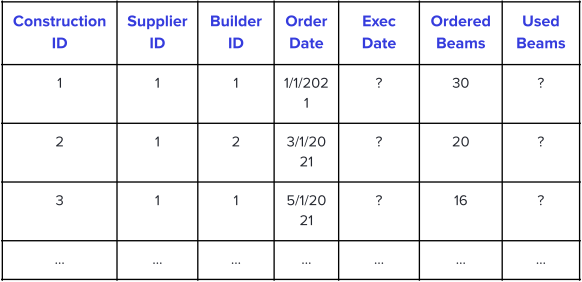
Let’s consider the following data entities and associated historical data for this problem:
Supplier
Dispatches the raw materials we need.
Supplier ID
ZIP Code
Builder
Executes the construction.
Builder ID
ZIP Code
Construction
The site which is being built.
Location
Construction Type (Residential/Industrial, industry type)
Building Area/Dimensions
Number of expected workers
Material
A material request.
Material Type (e.g. Cement, beams, rebars)
Characteristics: e.g. – Amount of Cement 3000kg, T-bar beams width 3”, rebars 1/2”, strength, …
For each stakeholder involved in the process, there are things causing uncertainty in the questions described above. We may over or underestimate the amount/quality of the required materials (both from inaccurate information from the construction plans or from internal uncertainties in the estimates). The builders can waste or use in a more efficient way a certain material. The delay between order and execution depends on the complexity of the construction process, time of the year (holidays!), and supplier bottlenecks, among others.
Relevant Features
There are some relevant features that can be extracted to make this problem easier to predict:
Construction x Material: Amount and type of each material needed at order time and execution time for a certain construction. This tells us which constructions over- and underestimated certain materials, and what was the delay between order and execution. It will be used for building the targets of our problem.
Builder/Supplier: Statistics for the historical differences in material amount/characteristics between order time and execution time (e.g. ordered 3 tons cement, only needed 2.5 in the past 3 months, on average)
Time: Time of the year (month, quarter, season, …) and historical features on the difference between order time and execution time.
Modeling
For simplification purposes, let’s assume we only want to predict a single material: e.g.beams needed for a single unit in the construction.
We need to determine:
Required number of beams
Time until the order is executed, after it’s ordered with some initial characteristics
Option 1 – Multitask Regression Model
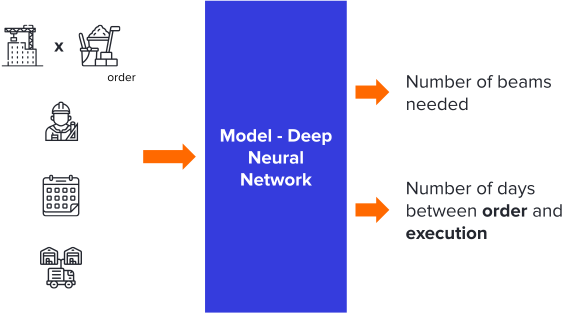
In this initial approach, we take the features at order time and try to predict the number of beams needed, and the number of days between order and execution. This is done using a multitask model, with two regression tasks.
The advantages of this approach are that it is easy to set up, the targets are easy to interpret, makes the model more robust, and might increase the performance. However, there are several disadvantages:
There’s a set of defined templates for the beams (SKU – Stock Keeping Unit) and the model might be predicting beam configurations that do not exist!
Hard decision process: There’s no way to measure prediction confidence when all you have is a value.
Difficult convergence: the domain of possible values is very large, and it’s not easy to tell if a prediction is good or not.
Option 2 – Multitask Classification
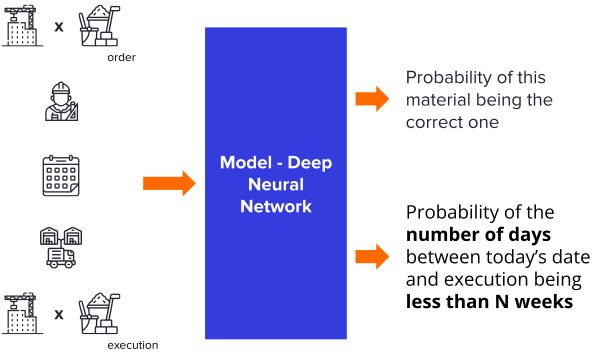
We can alternatively build a multitask classification model, where we consider two tasks:
whether or not the execution beams in our hypothesis matched a certain beam in stock. This means we will have to create artificial samples in our dataset: 1 positive row and N negative rows, where N is the number of possible beams.
Probability of the number of days between today’s date and execution being less than N weeks. This will require generating random dates between order date and execution date. The value of N is determined according to the needs of production and transportation to storage places by our client.
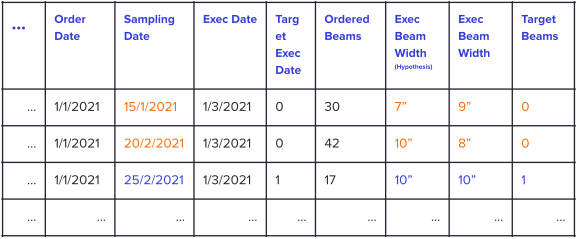
The table below shows an example of what this artificial sampling would look like:
Sampling Date: Randomly sampled dates between order_date and execution_date
Execution Beam Width (hypothesis): The comparison we’re performing. These are the values of beams that are in stock.
Execution Beam Width: What really happened. We use the comparison to “Execution Beam Width (hypothesis)” as a target.
In blue are shown the rows where the target is positive, and in orange where they are negative. For instance, a sampling date of 25/2/2021 is close enough to our execution date to consider it as a positive target for prediction, while 20/2/2021 is not. In terms of execution beams, the target is positive when the pre-orders and the execution matches.
Model Architecture
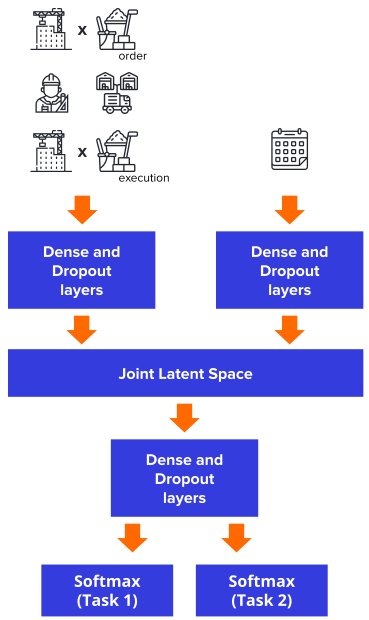
Regarding model architecture, we can build a two-stream model: we separate the features belonging to the delay between order and execution and the difference between ordered and executed material, since we’ll have multiple rows with similar features, and this tells the model to treat them differently in an explicit way.
The proposed architecture is relatively simple: a set of dense and dropout layers, followed by an aggregation operation (e.g. concatenation). Afterward, another set of Dense/Dropout layers transforms this concatenated latent space. In the bottom, two different softmax layers, one for each task, are added.
Compared to Option 1, this architecture has the advantage of allowing a decision process based on prediction confidence and only predicting items that the client is able to produce. However, the process complexity is higher: you need to create positive and negative training samples, and it is harder to set up.
We can also add custom penalizations in our loss function according to the business problem. If we predict 30 beams in a building that needs 20, it’s ok. If it needs more, it will not be sufficient. When the model doesn’t predict the same material, but a compatible one, we can punish it less. When it’s not, punish it more.
Decision Process
Building a multitask classification model allows us to create a decision process based on the expected value. Namely, what’s the probability P of needing K units of a product has an expected value of P x K units.
To know which materials to keep in stock for the next N weeks, the expected value for all constructions that are ordered and not yet executed can be summed.
Impact Measurement
What metrics would be important to measure?
Internally, for building and evaluating your model, you can use Machine Learning metrics:
Classification: PR AUC, ROC AUC, …
Regression: Mean Absolute Error, Mean Squared Error…
But this tells nothing about how good the model is at predicting the amount you need to stock. You need to measure business metrics as well:
How many products did we predict/produce in excess because no one purchased them
How many products didn’t we predict/produce on time, leading to an extra delay in the construction
Conclusion
This article has shown some different ways you can think about product forecasting problems, where there are a lot of products with similar characteristics.
We only cover the specific case of forecasting a single product type (beams) with different characteristics. However, this could be generalized for different products – such as the amount of cement needed – by adapting the model. Since there are no “cement SKUs”, and any amount predicted is valid, you can replace the sigmoid classification with a linear layer, and create a regression model together with binary classification for the time delay.
Like this story?
Subscribe to Our Newsletter
Special offers, latest news and quality content in your inbox.
Signup single post
Recommended Articles
Article
Transform Your Growth with custom ai software development in 2026
Apr 1, 2026 in
Guide: Explainer
Explore how custom ai software development can boost efficiency, cut costs, and deliver measurable value - find trusted partners and practical steps for 2026.
Discover how AI for customer service can transform your support operations. Learn practical strategies to reduce costs, improve satisfaction, and drive growth.
How Might We Statements: Turn Challenges into Opportunities
Mar 15, 2026 in
Guide: Explainer
Discover how might we statements transform complex challenges into real opportunities. Learn practical crafting tips, workshops, and real-world examples.
We use cookies on our website to give you the most relevant experience by remembering your preferences and repeat visits. By clicking “Accept All”, you consent to the use of ALL the cookies. However, you may visit "Cookie Settings" to provide a controlled consent.
This website uses cookies to improve your experience while you navigate through the website. Out of these, the cookies that are categorized as necessary are stored on your browser as they are essential for the working of basic functionalities of the website. We also use third-party cookies that help us analyze and understand how you use this website. These cookies will be stored in your browser only with your consent. You also have the option to opt-out of these cookies. But opting out of some of these cookies may affect your browsing experience.
Necessary cookies are absolutely essential for the website to function properly. These cookies ensure basic functionalities and security features of the website, anonymously.
Cookie
Duration
Description
cookielawinfo-checkbox-analytics
11 months
This cookie is set by GDPR Cookie Consent plugin. The cookie is used to store the user consent for the cookies in the category "Analytics".
cookielawinfo-checkbox-functional
11 months
The cookie is set by GDPR cookie consent to record the user consent for the cookies in the category "Functional".
cookielawinfo-checkbox-necessary
11 months
This cookie is set by GDPR Cookie Consent plugin. The cookies is used to store the user consent for the cookies in the category "Necessary".
cookielawinfo-checkbox-others
11 months
This cookie is set by GDPR Cookie Consent plugin. The cookie is used to store the user consent for the cookies in the category "Other.
cookielawinfo-checkbox-performance
11 months
This cookie is set by GDPR Cookie Consent plugin. The cookie is used to store the user consent for the cookies in the category "Performance".
viewed_cookie_policy
11 months
The cookie is set by the GDPR Cookie Consent plugin and is used to store whether or not user has consented to the use of cookies. It does not store any personal data.
Functional cookies help to perform certain functionalities like sharing the content of the website on social media platforms, collect feedbacks, and other third-party features.
Performance cookies are used to understand and analyze the key performance indexes of the website which helps in delivering a better user experience for the visitors.
Analytical cookies are used to understand how visitors interact with the website. These cookies help provide information on metrics the number of visitors, bounce rate, traffic source, etc.
Advertisement cookies are used to provide visitors with relevant ads and marketing campaigns. These cookies track visitors across websites and collect information to provide customized ads.