Agriculture’s role and its importance is not strange to any of us. Besides feeding us all, it allowed the first settlements and the transition from a nomad lifestyle to a sedentary way of living that culminated in the current state of our civilization. Although there is already a lot of IoT technology and innovation being introduced in the past years, there is still lots of room for improvement.
The widespread use of Artificial Intelligence allied with climate change, population growth, shortage of agricultural workers, and food security concerns, propelled the agro field into seeking even more innovative approaches to increase their yields.
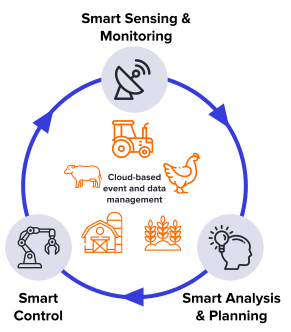
The picture above, adapted from here, suggests that robots can play an important role in control, but it can be expected that the role of humans in analysis and planning is increasingly assisted by machines so that the cycle becomes almost autonomous. Supporting this is the projection of the agricultural AI market from $519 million, by 2019, to $2.6 billion by 2025, according to a Markets and Markets Report in 2019. In this blog post, we will dive into the popular applications and common use cases of AI in agriculture.
Course, Templates
Data Ignite
Discover the potential of any AI use case in your business following our methodology.
The agriculture sector consumes 85% of the available freshwater in the world, and this percentage is rapidly increasing with the population growth and food demand. When dealing with open space agriculture, it is common to see irrigation systems that are highly inefficient resulting mostly in water wastage instead of soil moisture. By dispersing sensors measuring temperature, humidity, pH, and soil moisture throughout the fields it is possible to irrigate with precision just the regions that need to be irrigated in a completely automated manner. The sensor data associated with each field section is modeled to trigger a valve to that specific region of the field.
Besides this, plant evapotranspiration is also impacted by a plethora of atmospheric parameters such as humidity, wind speed, solar radiations, and even the crop factors such as the stage of growth, plant density, soil properties, and pests. These can be modeled similarly to the approach before, see the work of Patil et al..
Leaf disease detection
It is estimated that diseases correspond to a big chunk in crop yield losses. The most widely used practice in pest and disease control is to uniformly spray pesticides over the cropping area. This practice, although effective, has a significant financial and environmental cost.
Traditionally, disease detection can be manually done by observing the color of the leaves and the presence of spots. However, it has been leveraged by computer vision systems that are able to segment these affected leaf regions and classify them as being associated with a disease or not. Companies like SkySquirrel Technologies use drone-based aerial imaging to monitor the health of farms and aid farmers on when and where to deploy the pest controls.
In a similar use case, concerning wheat, one of the most economically significant crops worldwide, Pantazi et al. developed a new system to differentiate between diseased and healthy crops. The system detected nitrogen stressed, yellow rust infected, and healthy winter wheat canopies based on hierarchical self-organizing classifier and hyperspectral reflectance imaging data.
Weed detection
Weed detection and management is another significant problem in agriculture. Many producers indicate weeds as the most important threat to crop production. The accurate detection of weeds is of high importance given the difficulty to detect and discriminate between crops. Competition between crops and undesired weeds accounts for over $11 billion according to research conducted in India, see here. And thus, removing these weeds from the fields is of utmost importance to prevent space to be occupied and negatively impacting the growth of the crops.
To implement a system with this use case is first necessary to differentiate the crops from the weeds, and, as we already know, computer vision is a powerful tool for doing so. Afterward, micro spraying or lasers can be used to remove the undesired guests. As an example, Tamouridou et al. presented a new method based on neural networks and multispectral aerial images for the identification of Silybum marianum, a weed that is hard to eradicate and causes major loss in crop yield.
Drone related use cases
Aerial crop monitoring has been gaining momentum thanks to drones. With the recent advances and the diminishing technology prices, more research has been conducted with practical applications.
These unmanned aircraft are being used to monitor crop health, irrigation equipment, herd, and wildlife, identify weeds and manage disasters. Besides this, using their digital imaging systems, one can obtain field elevation information that then can be used to detect drainage patterns and wet/dry spots.
Farm management can also be used by real-time operation monitoring to guarantee that everything is running smoothly. Drone usage based on Computer Vision techniques for product spraying and fertilization can achieve higher precision than using conventional tractors and are a safer option for workers that do not have to spray the plants manually and in close contact.
New sensors mounted on drones, with high-tech cameras being the eyes of the client on the ground and optimal procedures for the survey, data acquisition, and analysis are continuously developed and tested, but this is not new. Satellites have been used for more than a decade to inspect large croplands and forestry, but their precision and flexibility cannot rival the usage of drones. Below you can see examples of drone usage, extracted from here.
Yield mapping
Yield prediction on a field portion level can be predicted by using a combination of machine learning techniques to analyze 3D mapping from sensor data and drone-based data of soil color. With these inputs, agriculture specialists can then predict the potential soil yield for a given crop.
In a study, authors developed an early yield mapping system for the identification of immature green citrus in a citrus grove under outdoor conditions, see Sengputa et al.. This system comprised texture classification by a support vector machine (SVM), Canny edge detection combined with a graph-based connected component algorithm, and Hough line detection. In another study, the authors developed a model for the estimation of grassland biomass based on neural networks and multitemporal remote sensing data such as vegetation indices, spectral bands of red and NIR. In China, methods to predict the rice development stage based on SVM and basic geographic information obtained from weather stations were implemented, see this paper for more. Below, we can see a visual representation of the yield prediction extracted from here.
Surveillance
Although it may not be as directed to agriculture as the others, it is still a need present in the field. Farmers have to monitor large areas of land and it can certainly be done using computer vision systems. By doing so, one can reduce the domestic and wild animal’s potential to accidentally destroy crops or experience a break-in or burglary at a remote farm location.
There are already various services present in the market for some of the use cases described above, as can be seen in the table below, extracted from here:
As seen throughout this blog post, the trend in agriculture is set to be towards big data, and the use of AI. For more on this topic see these two broad reviews on the topic (this paper and this one). We hope that the use cases discussed have widened the reader’s vision on this topic, and, as usual, feel free to contact us if you have any doubts!
Special offers, latest news and quality content in your inbox.
Signup single post
Recommended Articles
Article
Transform Your Growth with custom ai software development in 2026
Apr 1, 2026 in
Guide: Explainer
Explore how custom ai software development can boost efficiency, cut costs, and deliver measurable value - find trusted partners and practical steps for 2026.
Discover how AI for customer service can transform your support operations. Learn practical strategies to reduce costs, improve satisfaction, and drive growth.
How Might We Statements: Turn Challenges into Opportunities
Mar 15, 2026 in
Guide: Explainer
Discover how might we statements transform complex challenges into real opportunities. Learn practical crafting tips, workshops, and real-world examples.
We use cookies on our website to give you the most relevant experience by remembering your preferences and repeat visits. By clicking “Accept All”, you consent to the use of ALL the cookies. However, you may visit "Cookie Settings" to provide a controlled consent.
This website uses cookies to improve your experience while you navigate through the website. Out of these, the cookies that are categorized as necessary are stored on your browser as they are essential for the working of basic functionalities of the website. We also use third-party cookies that help us analyze and understand how you use this website. These cookies will be stored in your browser only with your consent. You also have the option to opt-out of these cookies. But opting out of some of these cookies may affect your browsing experience.
Necessary cookies are absolutely essential for the website to function properly. These cookies ensure basic functionalities and security features of the website, anonymously.
Cookie
Duration
Description
cookielawinfo-checkbox-analytics
11 months
This cookie is set by GDPR Cookie Consent plugin. The cookie is used to store the user consent for the cookies in the category "Analytics".
cookielawinfo-checkbox-functional
11 months
The cookie is set by GDPR cookie consent to record the user consent for the cookies in the category "Functional".
cookielawinfo-checkbox-necessary
11 months
This cookie is set by GDPR Cookie Consent plugin. The cookies is used to store the user consent for the cookies in the category "Necessary".
cookielawinfo-checkbox-others
11 months
This cookie is set by GDPR Cookie Consent plugin. The cookie is used to store the user consent for the cookies in the category "Other.
cookielawinfo-checkbox-performance
11 months
This cookie is set by GDPR Cookie Consent plugin. The cookie is used to store the user consent for the cookies in the category "Performance".
viewed_cookie_policy
11 months
The cookie is set by the GDPR Cookie Consent plugin and is used to store whether or not user has consented to the use of cookies. It does not store any personal data.
Functional cookies help to perform certain functionalities like sharing the content of the website on social media platforms, collect feedbacks, and other third-party features.
Performance cookies are used to understand and analyze the key performance indexes of the website which helps in delivering a better user experience for the visitors.
Analytical cookies are used to understand how visitors interact with the website. These cookies help provide information on metrics the number of visitors, bounce rate, traffic source, etc.
Advertisement cookies are used to provide visitors with relevant ads and marketing campaigns. These cookies track visitors across websites and collect information to provide customized ads.